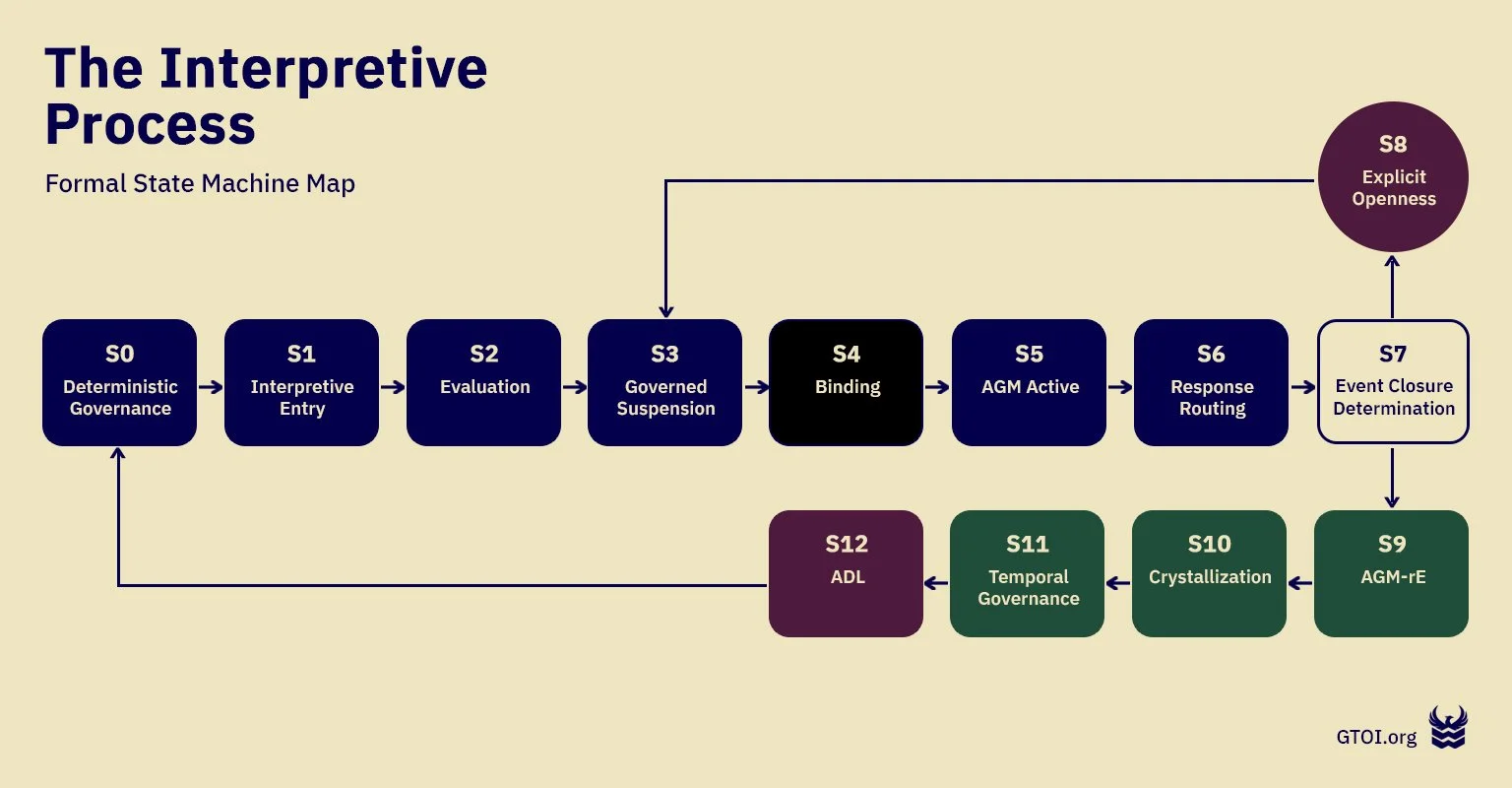
The Interpretive Process
How signals become action
Introduction
The interpretive process describes how systems decide what something means and what to do next. Most of the time, existing understanding is enough to guide action. But when the situation no longer fits the usual expectations, interpretation begins. Possible meanings compete until one becomes the basis for action.
This page explores that process in three forms:
Conceptual Overview — A simple walkthrough of the process using a familiar example of a hiring manager trying to decide what a job candidate really represents for the team.
Scientific Architecture — The canonical structural model used within the Institute’s research programs to describe how interpretation produces action-governing meaning.
Formal State Machine — A precise specification of the same process expressed as a machine-executable model suitable for computational systems and simulation.
A visual overview of the model is also available:
→ Interpretive Process Diagram
Each section presents the same system at a different level of detail.
Interpretive Process
Conceptual Overview
At some point, every system has to decide what something means and what to do about it.
Sometimes that decision is easy. Existing rules, expectations, or shared understanding already tell the system how to respond. When that happens, action can move forward without much discussion.
But situations often arise where the existing understanding no longer clearly applies. The circumstances may not fit what people expected. Different constraints may point in different directions. Or there may simply be no obvious way forward.
When that happens, the system has to stop and interpret.
The interpretive process describes how systems move from that moment of uncertainty to a new shared meaning that can guide action.
To illustrate, imagine a hiring manager conducting a job interview.
1. When the usual answer no longer works
Most of the time, systems operate under meanings that have already been established.
A hiring manager usually has a sense of what a “strong candidate” looks like. Past hires, job requirements, and team expectations provide a baseline for evaluating applicants.
As long as a candidate clearly fits that picture, the decision is straightforward.
But sometimes an interview produces mixed signals. A candidate may have an unusual background, strong strengths in one area and gaps in another, or answers that don’t neatly match the STAR.
Now the usual interpretation no longer clearly applies. The system pauses and interpretation begins.
2. Someone has to decide what counts
Before a new interpretation can guide action, the system must determine who is allowed to decide.
In a hiring process, that authority might belong to a hiring manager, a panel, or a committee. Different people may provide input, but someone ultimately has responsibility for deciding how the signals should be interpreted.
This step establishes interpretive jurisdiction.
Once jurisdiction is clear, possible interpretations can be considered.
3. Different ways to understand the situation
At first, several interpretations may exist at the same time.
The hiring manager might think:
“This candidate is inexperienced for the role.”
“This candidate has unusual potential.”
“This candidate might be better suited for a different position.”
All of these interpretations remain possible while the system evaluates them.
The interview panel might discuss the candidate’s responses, review their work history, and consider how they might perform on the team.
For a while, the system holds multiple possibilities open.
4. The moment the system has to choose
Eventually the system reaches a point where it cannot keep postponing the decision.
The team must either move the candidate forward, decline them, or escalate the decision to someone else.
At this moment, the system commits to a single interpretation of what the candidate represents.
Perhaps the hiring manager concludes:
“This candidate isn’t fully qualified today, but the long-term upside is strong.”
This is the point where the system binds to one meaning.
5. Meaning becomes action-guiding
Once a meaning is bound, it becomes the interpretation that guides what happens next.
In this example, the candidate is now understood as a high-potential hire rather than simply an inexperienced applicant.
That interpretation changes how the system evaluates possible actions. The hiring manager may now consider options such as mentorship, training support, or a slightly adjusted role.
The meaning now governs the decision space.
6. Turning meaning into a decision
Next, the governing meaning must be translated into a specific action.
The hiring manager might:
extend an offer
request another interview
escalate the decision to a senior leader
decline the candidate
This step converts interpretation into an operational decision.
7. The meaning often continues afterward
After the decision, the interpretation that guided the decision often continues to shape future action.
If the candidate is hired under the interpretation that they have strong long-term potential, that expectation may guide how the manager evaluates their early performance.
The system continues to operate under the meaning that was chosen.
8. But meanings do not last forever
Over time, conditions may change.
Perhaps the employee develops rapidly and exceeds expectations. Or perhaps the role evolves in ways that make the original interpretation less accurate.
Eventually the system may reach a point where the original understanding no longer clearly guides what to do next.
At that moment, interpretation must begin again.
The cycle
The interpretive process therefore forms a recurring pattern:
existing meaning guides action → something no longer fits → interpretation begins → a meaning is chosen → action follows → the meaning persists for a while → conditions change → interpretation reopens.
This cycle is how systems continually translate signals into coordinated action.
Interpretive Process
Scientific Architecture
0. Domain Statement
All admissible systems evolve through Constraint-Governed State Resolution (CGSR).
For any system state:
σₜ₊₁ ∈ Ω(σₜ ; K)
where:
σₜ = current system state
Ω = continuation space generated by state and constraints
K = operative constraint structure
Continuation space represents the set of admissible successor states available under operative constraints.
When a governing baseline collapses continuation space to a single admissible successor state, response selection proceeds through deterministic governance.
When baseline governance can no longer uniquely collapse continuation space, Action Determinacy Loss (ADL) occurs.
ADL indicates that multiple admissible successor continuations remain available.
Within meaning systems, these alternative continuations are mediated through candidate interpretations, each of which implies a distinct trajectory of system continuation.
The interpretive process specifies the structural mechanism by which a system:
reduces multiple candidate continuation propositions to one governing continuation
restores response routing capacity
stabilizes governing meaning across system states
Interpretive stabilization follows the structural grammar specified by the 3E Theorem:
Entry → Evaluation → Exit
Within this grammar:
Entry establishes jurisdiction and candidate admissibility.
Evaluation governs candidate competition within the evaluation field.
Exit occurs at binding, where one candidate continuation becomes action-governing.
The interpretive process governs:
activation of interpretive jurisdiction
formation of candidate continuation propositions
governed suspension of competing candidates
movement toward binding under constraint interaction
production of Action-Governing Meaning (AGM)
deterministic response routing under AGM
event boundary determination (closure or explicit openness)
post-event reuse through AGM Re-execution (AGM-rE)
baseline stabilization through crystallization
temporal behavior of crystallized baselines (drift and determinacy margin)
reactivation through Action Determinacy Loss (ADL)
The interpretive process does not evaluate correctness, desirability, or legitimacy.
Authority and legitimacy are classified only at binding through meaning regimes and remain analytically distinct from determinacy.
1. Admissibility Preconditions
The interpretive process operates only within an admissible Meaning System.
An admissible meaning system specifies:
• declared boundary and membership condition
• operative reference conditions treated as in force
• admissible response pathways
• correction and revision pathways
• jurisdictional admissibility rules for binding
If deterministic response routing remains available under an existing governing baseline, interpretive stabilization is not required.
2. Deterministic Governance and Continuation Collapse
Deterministic governance exists when an active baseline collapses continuation space to a unique admissible successor state.
Deterministic governance therefore requires satisfaction of the determinacy conditions:
Fit
the governing baseline remains applicable to the situation under the operative reference conditions
Rank
competing constraints can be ordered into a decisive hierarchy capable of selecting among responses
Feasibility
at least one admissible response pathway exists to operationalize the governing constraint
Determinacy is binary.
When all three conditions hold:
Det(B, σₜ, R) = TRUE
and continuation space collapses to a unique successor.
If any condition fails:
continuation collapse fails
deterministic routing becomes impossible
interpretive jurisdiction activates
3. Entry: Interpretive Jurisdiction
Interpretive jurisdiction determines whose interpretations are eligible to bind within the declared system boundary.
Jurisdiction activates when deterministic routing cannot be completed under the existing baseline.
Activation establishes:
binding admissibility
responsibility for response selection
the boundary within which interpretive competition may occur
Without jurisdiction, interpretive activity may occur but cannot bind system action.
This stage corresponds to Entry in the 3E Theorem.
4. Candidate Formation and Continuation Propositions
Following jurisdiction activation, signals evaluated under operative reference conditions generate candidate interpretations.
Each candidate interpretation implies a continuation proposition:
qᵢ → τᵢ → σₜ₊₁⁽ᶦ⁾
where:
qᵢ = candidate interpretation
τᵢ = trajectory implied by the interpretation
σₜ₊₁⁽ᶦ⁾ = successor state implied by that trajectory
Candidate formation produces a CandidateSet admitted into the evaluation field.
Candidate formation:
does not determine commitment timing
does not determine candidate selection
5. Evaluation Field and Governed Suspension
After candidate formation, the system enters an evaluation field in which multiple candidate continuations remain admissible.
Within governed suspension:
multiple candidate interpretations coexist
candidates compete under shared evaluation constraints
reversal remains structurally possible prior to binding
commitment is not yet required
Governed suspension persists while multiple admissible continuation trajectories remain viable.
6. Interpretive Dynamics
Interpretive dynamics regulate candidate variability and competition within the evaluation field.
These dynamics are influenced by structural modulators:
Interfaces
variance importation across system boundaries
Coupling
dependency strength influencing urgency propagation and suspension affordability
Meaning Topology
distribution of interpretive pressure and constraint deployment within the system
Interpretive Bandwidth (IB)
structural limit on candidate multiplicity sustainable within the evaluation field
Interpretive dynamics influence the duration and structure of candidate competition but do not determine which candidate binds.
7. Constraint Interaction
Constraint interaction evaluates candidate continuation propositions against the operative constraint architecture under the declared reference conditions.
Constraint interaction progressively reduces admissible candidate variability.
Binding becomes structurally necessary when continued governed suspension becomes non-viable.
This threshold is referred to as constraint dominance.
Constraint dominance:
necessitates binding
does not determine which candidate binds
Constraint dominance therefore functions as a transition condition rather than an independent state.
8. Transition Regulation
Transition regulation governs the rate at which the interpretive event approaches binding.
Transition forces include:
Transition Drivers (β₆)
increase proximity to binding
reduce suspension duration
Transition Stabilizers (γ₆)
extend suspension duration
preserve candidate variability
Transition forces regulate commitment timing but do not determine candidate selection.
9. Exit: Binding and Regime Classification
Binding is the threshold at which one candidate continuation becomes action-governing.
Binding produces:
termination of candidate competition
Action-Governing Meaning (AGM)
Binding corresponds to Exit in the 3E theorem.
At binding, governance is classified under the operative meaning regime:
PCMR
binding under satisfied de jure conditions
DMR
binding without satisfied de jure conditions
Regime classification occurs only at binding.
Binding does not imply closure, persistence, or correctness.
10. Action-Governing Meaning (AGM)
AGM is the governing meaning produced by binding.
AGM specifies the operative continuation rule for the system.
AGM constrains response selection by determining which responses are:
permitted
required
deferred
escalated
inhibited
AGM precedes routing and does not determine event closure.
11. Deterministic Routing Under AGM
Response routing remains admissible only while determinacy holds under the AGM-derived baseline.
Routing requires:
Fit
Rank
Feasibility
If any condition fails:
routing cannot proceed
interpretive jurisdiction reactivates
12. Response Routing
Routing maps AGM to an admissible operational pathway.
Routing options are mutually exclusive:
Execute
Defer
Escalate
Inhibit
Routing operationalizes governing meaning but does not create legitimacy, meaning, or closure.
13. Event Closure State
An interpretive event may resolve through:
Closure
termination of the interpretive event
Explicit Openness
continuation of the event with reversibility preserved under the same jurisdiction
Closure state does not determine persistence or legitimacy.
14. Post-Event Governance: AGM Re-execution (AGM-rE)
After closure, previously bound AGM may govern subsequent system states without reactivating interpretation.
This reuse is AGM Re-execution (AGM-rE).
AGM-rE:
treats governing meaning as settled
routes response selection across states
persists only while determinacy holds
Crystallization is not required for AGM-rE.
15. Crystallization
Crystallization stabilizes governing meaning into a reusable baseline suitable for sustained cross-cycle operation.
Crystallization enables temporal analysis of governance behavior.
Crystallization:
does not create legitimacy
does not guarantee stability
does not alter regime classification
16. Temporal Governance: Drift and Determinacy Margin
After crystallization, baseline behavior across time is described through:
Drift
the rate at which inconsistencies accumulate within a crystallized governing baseline
Determinacy Margin
the structural distance between the current baseline condition and violation of any determinacy condition
Drift influences proximity to determinacy violation but does not imply partial determinacy.
17. Reactivation Trigger: Action Determinacy Loss (ADL)
Action Determinacy Loss occurs when baseline governance can no longer collapse continuation space to a unique successor state.
ADL occurs at the first violation of:
Fit
Rank
Feasibility
At ADL:
AGM-rE terminates
deterministic routing becomes impossible
interpretive jurisdiction reactivates
a new interpretive event begins
ADL is binary and threshold-defined.
18. Structural Summary
The interpretive process describes the continuation governance cycle within meaning systems.
Deterministic governance persists while determinacy holds and continuation space collapses to a unique successor.
Interpretation activates when baseline governance can no longer collapse continuation space.
Candidate interpretations introduce alternative continuation trajectories.
Binding selects one continuation as action-governing.
Routing operationalizes the governing continuation.
Closed events permit AGM reuse and potential crystallization.
Crystallized baselines exhibit drift and determinacy margin behavior across time.
Action Determinacy Loss reactivates interpretation when baseline governance fails.
Interpretive Process
Canonical State Machine Specification
0. Conceptual Basis
All systems evolve through Constraint-Governed State Resolution (CGSR).
For any admissible system state:
σₜ₊₁ ∈ Ω(σₜ ; K)
where Ω represents the Continuation Space generated by the current state and operative constraints.
When Baseline Governance is valid, the system collapses continuation space to a single admissible successor state, enabling deterministic routing.
When baseline governance can no longer uniquely collapse continuation space, Action Determinacy Loss (ADL) occurs.
ADL indicates that multiple admissible successor continuations remain available.
In Meaning Systems, admissible continuations are mediated through candidate interpretations that imply different system trajectories.
Interpretation is therefore the process by which a system selects one continuation trajectory from multiple admissible candidates.
Interpretive stabilization follows the structural law specified by the 3E Theorem:
Entry → Evaluation → Exit
This specification defines the state machine governing continuation selection under interpretive conditions.
1. System Preconditions
This machine operates only within an admissible Meaning System.
An admissible meaning system must possess:
• a declared boundary and membership condition
• operative reference conditions treated as in force
• admissible response pathways
• correction or revision pathways
• jurisdictional admissibility rules for interpretive binding
If these conditions are absent or contradictory, interpretive stabilization cannot operate as a governing mechanism and the machine does not enter S1.
2. Determinacy Conditions
Determinacy is a binary predicate evaluated over a governing baseline relative to a situation.
Det(B, σₜ, R) = TRUE if and only if all three conditions hold.
Fit
The governing baseline remains applicable to the situation under operative reference conditions.
Rank
Constraints within the baseline can be ordered into a decisive hierarchy capable of selecting among responses.
Feasibility
At least one admissible response pathway exists to operationalize the governing constraint.
When determinacy holds, baseline governance collapses continuation space to a single admissible successor state.
When any condition fails, continuation collapse fails and ADL occurs.
Determinacy remains strictly binary.
3. State Set
S0 Deterministic Governance
S1 Interpretive Entry
S2 Evaluation Field Activation
S3 Governed Suspension
S4 Binding
S5 Action-Governing Meaning Active
S6 Response Routing
S7 Event Closure Determination
S8 Explicit Openness Loop
S9 Post-Event Governance (AGM rE)
S10 Crystallization
S11 Temporal Governance
S12 Action Determinacy Loss (ADL)
4. Core Objects
Baseline
A governing meaning structure capable of collapsing continuation space to a single admissible successor pathway when determinacy holds.
Jurisdiction
The admissibility condition specifying whose interpretations are eligible to bind within the system boundary.
CandidateSet
The set of admissible candidate continuation propositions present in the evaluation field.
Each candidate meaning implies:
interpretation
→ trajectory
→ successor state
qᵢ → τᵢ → σₜ₊₁⁽ᶦ⁾
Candidates may arise through:
• signal interpretation
• inference
• memory recall
• interface variance importation
• reinterpretation within the event
CandidateSet membership may change dynamically during evaluation.
CandidateSet must contain at least one admissible candidate.
AGM
Action-Governing Meaning produced at binding.
AGM establishes a governing continuation rule used for routing and potential baseline formation.
ClosureOutcome
Closed
ExplicitOpen
RoutingChoice
Execute
Defer
Escalate
Inhibit
Regime
Regime classification occurs only at binding.
PCMR
DMR
5. Modulators (Non-State Parameters)
These parameters influence interpretive dynamics but do not constitute machine states.
Interfaces
Variance importation across system boundaries.
Coupling
Dependency strength controlling propagation of interpretive pressure across systems.
Interpretive Topology
Distribution of constraint deployment and interpretive pressure within the system.
Interpretive Bandwidth (IB)
Structural capacity of the evaluation field to sustain multiple candidate meanings simultaneously.
Transition Drivers (β₆)
Conditions that accelerate proximity to binding.
Transition Stabilizers (γ₆)
Conditions that extend the duration of governed suspension.
These modulators influence candidate competition dynamics but do not determine selection outcomes.
They operate primarily during S2–S3.
6. State Definitions
S0 Deterministic Governance
A governing baseline collapses continuation space to a unique successor state.
Det(B, σₜ, R) = TRUE
Transitions
If routing required
→ S6
If determinacy fails
→ S12
S1 Interpretive Entry
Interpretive stabilization activates following ADL.
Operations
• activate interpretive jurisdiction
• establish candidate admissibility rules
• confirm operative reference conditions
Output
Jurisdiction = J
Transition
→ S2
S2 Evaluation Field Activation
The evaluation field becomes active under jurisdiction J.
Candidate meanings enter the evaluation field.
Each candidate implies a continuation trajectory.
Transition
→ S3
S3 Governed Suspension
Multiple candidate meanings coexist under governed suspension.
Candidates are compared through:
Fit
Comparability
Rank
Interpretive dynamics regulate candidate competition.
Interpretive Bandwidth constrains simultaneous candidate multiplicity.
Transitions
Remain in S3 while suspension remains viable.
→ S4 if CandidateSet collapses to a single candidate.
→ S4 if constraint dominance occurs.
Constraint dominance is treated as a transition condition rather than a state.
S4 Binding
Candidate competition terminates.
One candidate interpretation becomes governing.
Outputs
AGM
Regime ∈ {PCMR, DMR}
Binding corresponds to Exit in the 3E theorem.
Transition
→ S5
S5 Action-Governing Meaning Active
AGM becomes the governing interpretive stance.
The selected continuation trajectory becomes operative.
Routing has not yet occurred.
Transition
→ S6
S6 Response Routing
AGM is mapped to a RoutingChoice.
Routing requires
Det(AGM-derived baseline, σₜ, R) = TRUE
Fit and Rank here operate as determinacy predicates distinct from evaluation use during S3.
Transitions
If determinacy fails
→ S1
If RoutingChoice = Defer and event remains active
remain in S6
If RoutingChoice = Escalate
new jurisdiction activates
→ S1
If routing decision issued
→ S7
S7 Event Closure Determination
Determine whether the interpretive event resolves or remains open.
ClosureOutcome ∈ {Closed, ExplicitOpen}
Transitions
Closed → S9
ExplicitOpen → S8
S8 Explicit Openness Loop
The interpretive event remains active.
AGM continues governing but reconsideration remains admissible within the same jurisdiction.
Transition
→ S3
S9 Post-Event Governance (AGM rE)
Previously bound AGM governs without reactivating interpretation.
AGM rE persists while determinacy holds.
Transitions
Remain in S9 if determinacy holds.
→ S10 if crystallization occurs.
→ S12 if determinacy fails.
S10 Crystallization
A governing continuation rule stabilizes into a reusable baseline.
Transition
→ S11
S11 Temporal Governance
A crystallized baseline governs system continuation across time.
Drift accumulates as an inconsistency rate within the baseline.
Determinacy margin represents structural distance to determinacy violation.
Transitions
Remain in S11 if determinacy holds.
→ S12 if determinacy fails.
S12 Action Determinacy Loss (ADL)
ADL occurs when baseline governance can no longer collapse continuation space to a unique successor state.
First violation of:
Fit
Rank
Feasibility
Operations
• terminate AGM rE under failed baseline
• deterministic routing becomes impossible
• interpretive stabilization activates
Transition
→ S1
7. Global Invariants
Binding occurs only under active jurisdiction.
Regime classification occurs only at binding.
Determinacy is binary.
ADL occurs at the first determinacy violation.
Explicit openness preserves the same event boundary.
Closure terminates the event boundary.
Drift applies only to crystallized baselines.
Reinterpretation after closure occurs only through ADL or initiation of a new interpretive event.
8. Structural Mapping to the 3E Theorem
Entry → S1
Evaluation → S2–S3
Exit → S4
After Exit, interpretation terminates and the system transitions into governance, routing, and temporal persistence.