Research Programs
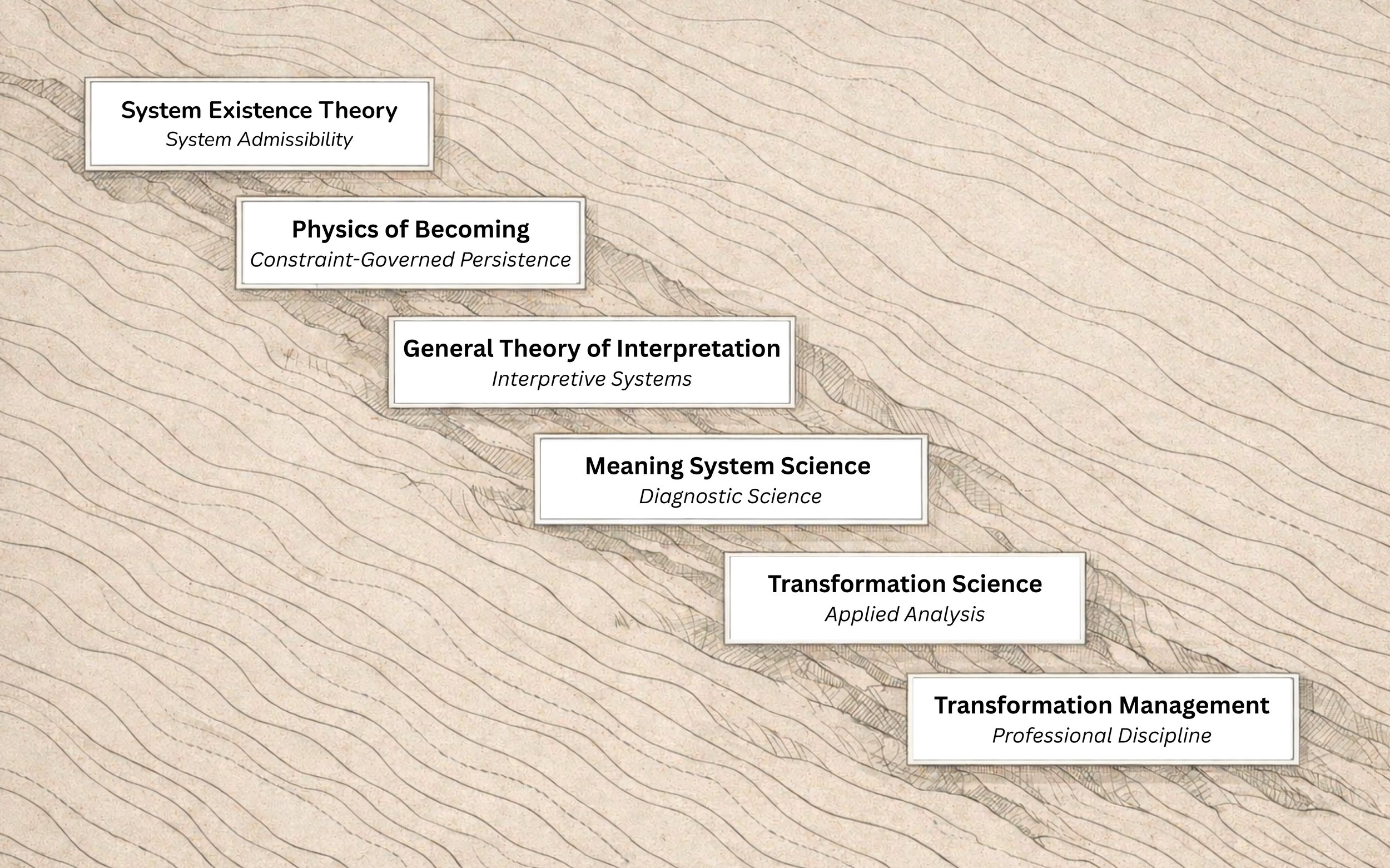
The Institute maintains four research programs with defined analytic dependencies. Each program specifies its object of analysis and follows its own publication pathway. The dependency order is:
System Existence Theory (SET) → Physics of Becoming (POB) → General Theory of Interpretation (GTOI) → Transformation Science
System Existence Theory (SET)
SET specifies when a candidate unit qualifies as a system at a stated boundary. It addresses a prior question to modeling and evaluation: whether systemhood holds before behavioral, interpretive, or performance claims are formed.
SET establishes existence-level conditions for admissibility, including boundary validity, unit identity, and persistence criteria. It does not model state evolution, interpretation, meaning, or intervention.
→ View System Existence Theory
Physics of Becoming (POB)
Physics of Becoming specifies the substrate-general dynamics of system persistence across time. It formalizes constraint-governed state transition as a pre-interpretive condition of system continuity and treats state resolution under constraint as baseline.
POB presupposes SET and introduces no semantic, interpretive, normative, or agentic claims. It does not define meaning, interpretive mechanisms, governance doctrine, diagnostics, or intervention models.
→ View Physics of Becoming
General Theory of Interpretation (GTOI)
GTOI examines interpretation as a system behavior: how people, institutions, and automated environments determine what is occurring when information is incomplete, mediated, or contested.
GTOI specifies interpretive mechanisms, claim formation, boundary relevance for interpretation, and interpretive responsibility. It presupposes admissible system objects (SET) and the baseline dynamics of persistence across time (POB). It does not establish existence conditions or foundational physical dynamics.
This program includes Meaning System Science (MSS), which treats meaning as a coordination technology within interpretive systems and maintains the Institute’s official terminology and canon reference structure.
Transformation Science
Transformation Science examines coordinated change attempts as time-extended events under constraint. It treats the transformation attempt as its primary object of analysis and specifies when change can be analyzed as a coherent attempt rather than a collection of initiatives.
The program analyzes attempt trajectories and failure patterns without prescribing methods or governance actions. It presupposes SET, POB, and GTOI, and provides the analytic foundation for Transformation Management, which applies these models within professional and institutional practice.
→ View Transformation Science
→ View Transformation Breakdown Signatures