

The General Theory of Interpretation
1. Canonical Definition
The General Theory of Interpretation (GTOI) specifies the structural requirements under which interpretation remains reliable across interpreters, environments, implementations, and time.
GTOI treats interpretation as a system-level process constrained by reference promise, signaling, routing, correction, and closure behavior. Within an interpretive event, meaning becomes operational at binding: the threshold at which an interpretation becomes governing for action and begins constraining response pathways. It explains reliability as a property of a stated system object under stated constraints, not as a function of individual belief, intent, temperament, or local domain content. Under GTOI, valid interpretive claims must be stated within an explicit boundary and membership condition and evaluated through checkable traces such as reference artifacts, signal streams, decision pathways, correction behavior, and closure outcomes. After closure, governing meaning may persist under a post-closure meaning regime (PCMR or DMR) until Action Determinacy Loss (ADL) forces interpretive re-activation; these are governance and transition classifications, not event-internal commitment dynamics.
GTOI is content-agnostic: it governs the reliability of interpretation, not the correctness of any single conclusion.
GTOI is the Institute’s primary research program. It produces Meaning System Science (MSS) as its operational layer, and it is used alongside System Existence Theory (SET) and Transformation Science to evaluate interpretation inside admissible systems and across change attempts.
MSS specifies a minimal variable architecture for interpretive reliability: Truth Fidelity (T), Signal Alignment (P), Structural Coherence (C), Drift (D) as inconsistency accumulation rate, and Affective Regulation (A). GTOI states the general requirements. MSS makes those requirements measurable and comparable in real environments.
GTOI is distinct from domain-specific theories of textual, legal, or hermeneutic interpretation. It treats interpretation as a cross-domain and cross-substrate phenomenon class: wherever signals must be evaluated relative to a declared reference promise and routed into action under constraint, interpretive reliability is conditioned by the same structural requirements, even when implementation mechanisms differ.
2. Foundational Thinkers: GTOI cites prior work as lineage, not attribution. The thinkers below are included as antecedents for specific component conditions later formalized in the Meaning System Science architecture.
-
![Black and white photo of a smiling man with short, light-colored hair, wearing a plaid shirt, a striped tie, and a suit jacket, standing outdoors with trees in the background.]()
Alfred Tarski
Truth conditions and semantic constraint; informs Truth Fidelity as evaluability under declared reference promises.
-
![Black and white portrait of a man with a large mustache, wearing a suit with a tie, looking slightly to the side.]()
Ferdinand de Saussure
Sign structure and differential meaning; informs Signal Alignment as encoded form independent of referent access.
-
![Black and white portrait of a serious-looking man with slicked-back hair, wearing a dark suit and tie.]()
Ludwig von Bertalanffy
General systems, boundaries, and organized relations; informs Structural Coherence as architecture for stable interpretation across interfaces.
-
![Black and white photo of a man in a suit and tie, looking to the side outdoors.]()
Ilya Prigogine
Non-equilibrium stability and irreversible dynamics; informs Drift as a rate under throughput and constraint.
-
![Black and white portrait of a woman with short hair and earrings.]()
Lisa Feldman Barrett
Constructed affect and regulation as capacity; informs Affective Regulation as interpretive viability under uncertainty and consequence.
-
![]()
Jack Bogle
Institutional stewardship and incentive integrity; informs Legitimacy as trustworthiness produced by structure, not rhetoric.
-
![]()
Robert Kegan
Subject object development and complexity capacity; informs interpretive mismatch as a structural limit on what can be held as object.
-
![]()
Miranda Fricker
Epistemic injustice as credibility and interpretability failure; informs reception dynamics via testimonial and hermeneutical failure classes.
-
![]()
Claude Shannon
Channel capacity and noise-bounded transmission; informs Signal Alignment as an engineering constraint while bracketing semantics.








Figure 1. A map of the GTOI canon
The canon is organized as adjacent domains within one landscape, not a linear sequence. The path traces the core conceptual arc.
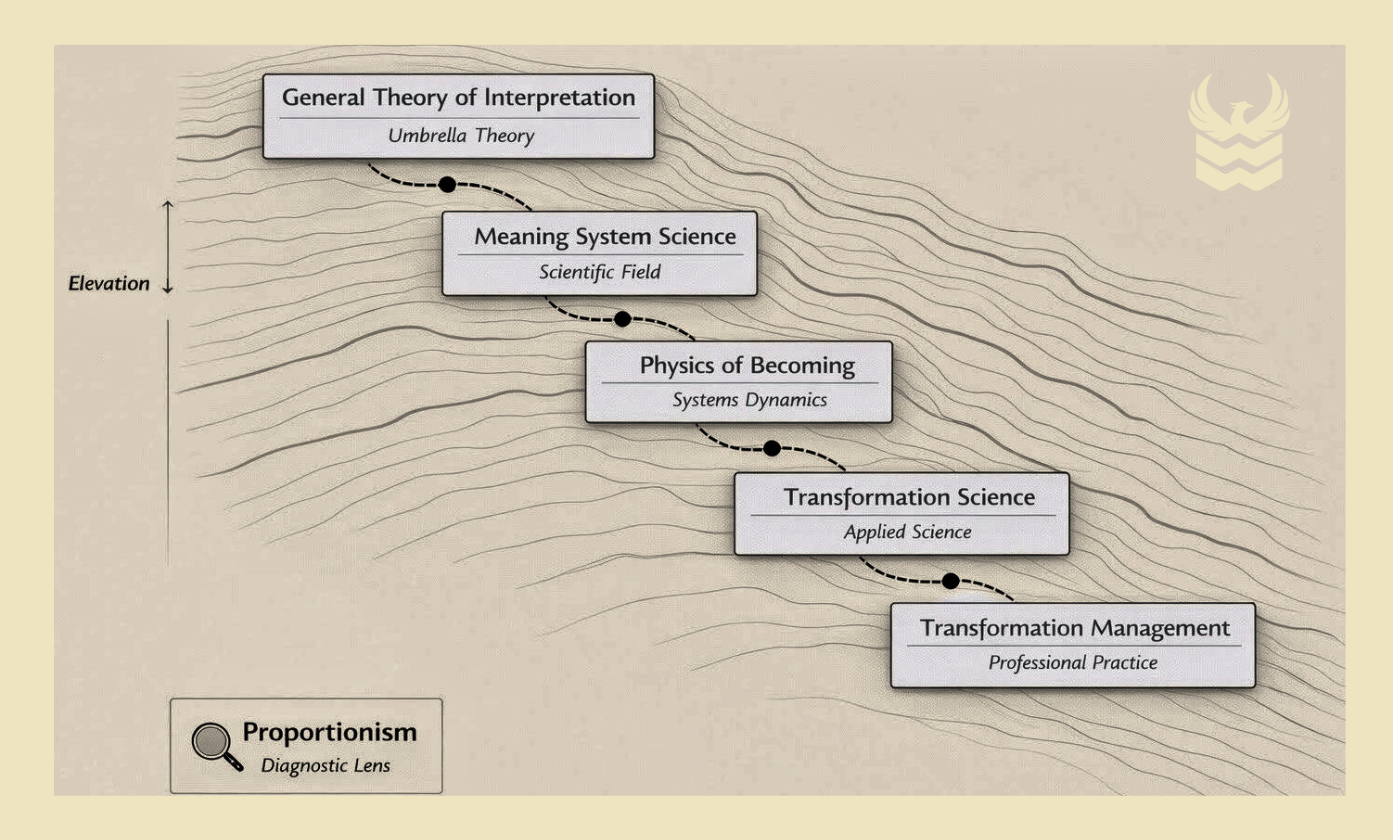
Figure 1. A map of the GTOI canon
These domains are connected regions of one landscape, not a required sequence; the path marks the main conceptual through-line.
3. Plainly
GTOI explains what must be true for a system to produce compatible meaning from the same conditions. It makes interpretation analyzable as a general system behavior across biological, organizational, institutional, cultural, and artificial environments.
4. Scientific Role in the General Theory of Interpretation
GTOI defines the constraint class for interpretation at scale. It:
defines interpretation independently of domain
specifies the stability conditions that enable coordinated action across roles and time
provides the theoretical basis for MSS variable architecture and law formation
GTOI defines what interpretation requires. MSS defines how those requirements can be evaluated in real systems.
5. Relationship to the Variables (T, P, C, D, A)
T, Truth Fidelity: stable reference conditions and verification discipline
P, Signal Alignment: convergent signals across roles, channels, and authorities
C, Structural Coherence: usable pathways and decision structures that distribute meaning consistently
D, Drift: rate of accumulated contradiction when stabilizers lose proportionality under load
A, Affective Regulation: regulation conditions determining update capacity and correction throughput under pressure
6. Relationship to the Physics of Becoming
L = (T × P × C) ÷ D
GTOI supplies the interpretive basis for legitimacy as proportional stability. It defines why drift rate relative to stabilizers is the governing condition for reliability at scale.
7. Application in Transformation Science
Transformation Science applies GTOI and MSS to systems undergoing change by modeling variable movement over time, proportional imbalance under pressure, and when accumulated drift requires structural reconfiguration.
8. Application in Transformation Management
Transformation Management operationalizes interpretive governance by designing decision environments that preserve shared meaning, maintaining alignment across roles and channels, and detecting rising drift rates before interpretive failure becomes systemic.
9. Example Failure Modes
identical directives produce incompatible interpretation because reference conditions differ
interpretations bind differently across roles or channels, producing incompatible routed actions from the same declared reference conditions
signals produce inconsistent action because authority cues vary across roles
pathways do not support consistent distribution of meaning across time
contradiction accumulation exceeds correction throughput, increasing drift rate
regulation capacity is insufficient for load, reducing update and correction performance
10. Canonical Cross References
Meaning System Science • Interpretation • Meaning System • Physics of Becoming • First Law of Moral Proportion • Proportionism • Legitimacy (L) • Truth Fidelity (T) • Signal Alignment (P) • Structural Coherence (C) • Drift (D) • Affective Regulation (A) • Semantics • Semeiology • Systems Theory • Thermodynamics (Meaning System) • Affective Science • Interface • Transformation Science • Transformation Management • Meaning System Governance