


The Domain of Interpretation
What the General Theory of Interpretation (GTOI) addresses, and what it deliberately does not
The Domain of Interpretation
What the General Theory of Interpretation (GTOI) addresses, and what it deliberately does not
The Domain of Interpretation
What GTOI addresses, and what it deliberately does not
The Domain of Interpretation
What the General Theory of Interpretation (GTOI) addresses, and what it deliberately does not
Most fields ask: What should we do?
GTOI asks first: What situation are we acting inside?
Biology, neuroscience, psychology, communication, sociology, control, law, management, and AI governance each contribute essential answers. GTOI adds a prerequisite across them: the conditions that let people and institutions stay aligned on what is happening long enough to decide and coordinate.
GTOI complements these fields by making that interpretive prerequisite explicit.
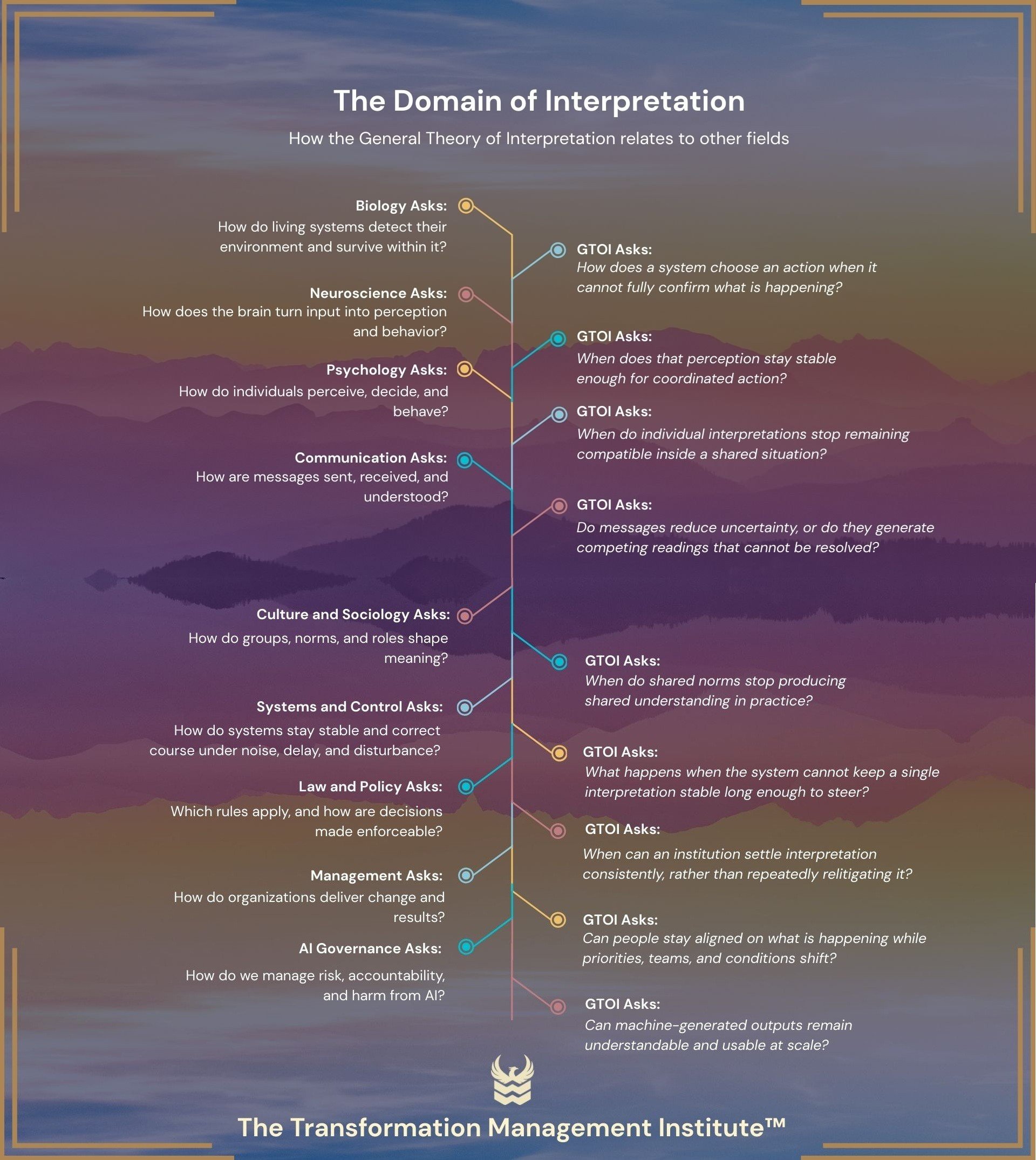
Figure 2. The Domain of Interpretation
Left side: the primary questions each field is designed to answer. Right side: the interpretive questions that support shared situation recognition and coordinated action. This is an orientation map, not a taxonomy. Overlap across disciplines is expected.
Foundational Layer
System Existence Theory
The domains above presuppose an admissible system operating under constraint. Interpretation does not establish systemhood; it operates only within it.
Pre-interpretive admissibility conditions are defined by System Existence Theory.