

Interpretive Systems
Interpretive Systems
A Structural Classification Using the Algebra of Becoming
By: Jordan Vallejo
Transformation Management Institute
Abstract
The term interpretation is widely applied to processes ranging from animal cognition to machine learning and institutional decision-making. These uses often refer to structurally distinct processes. This paper provides a structural clarification.
Interpretation is defined as a process that arises when governing structures fail to determine a unique continuation of system behavior and multiple candidate meanings imply divergent future trajectories. Under these conditions, systems that generate candidate meanings from resolved input, sustain multiple admissible candidates, select among them, and bind a governing continuation perform interpretive resolution.
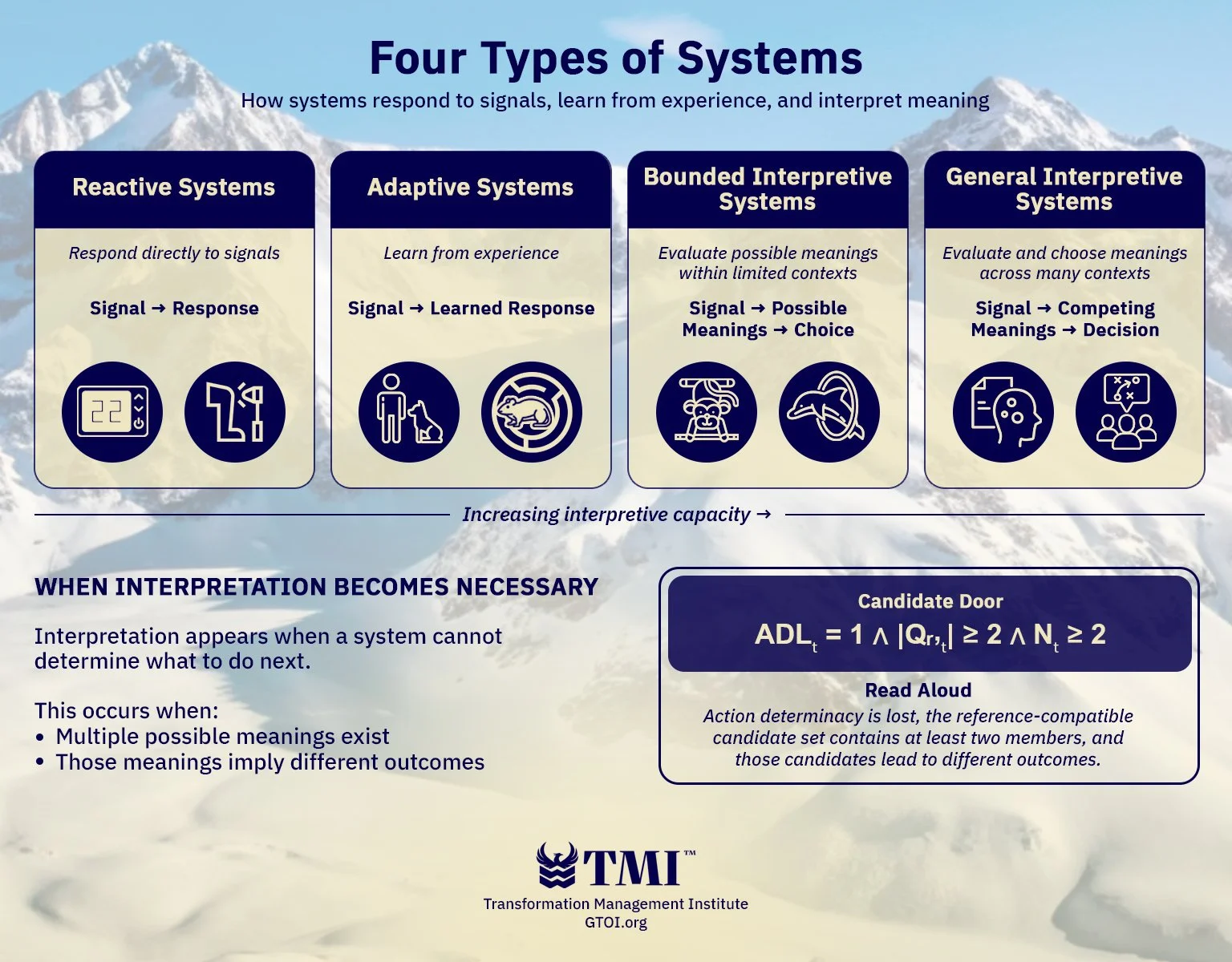
A formal theorem specifies the structural architecture required for interpretation. Systems are classified into reactive systems, adaptive systems, bounded interpretive systems, and general interpretive systems.
A strict boundary is established: systems that lack endogenous authority to bind governing meaning do not perform interpretation.
1. Introduction
The concept of interpretation appears across many domains of research. Animals are described as interpreting threats. Artificial systems are described as interpreting images or language. Humans and institutions are described as interpreting evidence, rules, and social signals.
These uses refer to processes that differ structurally. Interpretation is often conflated with signal processing, learning, classification, or prediction. This obscures the distinction between systems that adapt behavior and systems that determine meaning under indeterminate conditions.
This paper addresses a foundational question:
Which systems perform interpretation?
All systems operate over inputs derived from environmental signals. These signals are filtered, structured, and resolved into representations usable by the system. Many systems learn from such inputs and update behavior accordingly.
Interpretation is not required for these processes.
Interpretation becomes necessary when existing governing structures fail to determine a unique continuation and multiple competing continuations must be resolved under constraint.
2. Structural Conditions for Interpretation
At time t, a system occupies a realized state:
σₜ ∈ S
From this state, a set of admissible successor states exists:
Ωₜ = Ω(σₜ ; K)
where K denotes the operative constraint structure.
Under stable conditions, system behavior proceeds through governing structures that determine continuation:
Det(B, σₜ, R) = 1
Interpretation becomes necessary when this determinacy fails:
ADLₜ = 1
Under this condition, multiple admissible continuations remain available.
System input is a resolved representation constructed through processes of signal exposure, configuration, and resolution:
xₜ
Candidate meanings are generated:
Qₜ = Gen(xₜ, σₜ ; E)
Interpretation arises only when:
ADLₜ = 1
|Qᴿₜ| ≥ 2
Nₜ ≥ 2
These conditions establish:
failure of governing determinacy
multiplicity of admissible candidate meanings
divergence in implied continuation trajectories
Resolution proceeds:
ADLₜ → Qₜ → Qᴿₜ → Y_Q → q* → τ* → σₜ₊₁
3. Interpretive System Theorem
A system qualifies as an interpretive system if and only if it possesses structural mechanisms capable of the following operations under indeterminate continuation:
Generation of candidate meanings from resolved input
Sustained maintenance of multiple admissible candidates
Comparison of candidates as distinct continuation trajectories
Selection of one candidate as governing
Binding of the selected candidate into action-governing meaning
Endogenous authority to bind governing meaning
Endogenous authority is the system’s capacity to establish and enforce the selected meaning as governing over its own continuation without reliance on external binding agents.
Systems that lack endogenous binding authority do not perform interpretation.
4. Interpretation and Adaptive Response
Reactive systems map inputs directly to outputs through fixed routing.
Adaptive systems process structured input, learn from experience, and update mappings between inputs and responses.
These systems may filter signals, construct representations, classify inputs, and optimize outputs.
They do not sustain multiple competing continuation-implying candidates under indeterminate continuation. Their behavior is governed by learned mappings rather than selection among competing meanings.
Adaptive systems resolve input.
Interpretive systems resolve meaning.
5. Interpretive Systems and Meaning Systems
An interpretive system resolves competing meanings under indeterminate continuation and binds a governing meaning that determines system behavior.
A meaning system is a stabilized structure of governing meanings that regulates continuation across time.
Meaning systems emerge through repeated interpretive resolution. Once stabilized, they function as governing structures that reduce the need for interpretation until determinacy fails again.
6. Classification of System Types
Systems can be classified structurally:
Reactive systems
Direct signal-response routing without candidate generationAdaptive systems
Learning systems that update mappings without sustained candidate competitionBounded interpretive systems
Systems capable of candidate evaluation and binding within restricted domainsGeneral interpretive systems
Systems capable of sustained interpretive resolution across domains with endogenous binding authorityInstitutions
Distributed systems that perform collective interpretive resolution through structured binding processes
7. Animal Systems
Animal systems exhibit adaptive behaviors including learning, prediction, and coordination.
These behaviors include pattern recognition, associative learning, and context-sensitive response.
Some species display behavior consistent with evaluating alternative actions under uncertainty.
These processes operate within adaptive response structures. They do not exhibit sustained evaluation of multiple admissible candidate meanings as distinct continuation trajectories under shared constraint structures.
Animal systems do not establish and enforce governing meaning as a self-regulating structure across continuation.
Animal behavior proceeds through adaptive response rather than interpretive resolution.
8. Artificial Systems
Artificial systems perform large-scale signal processing, representation learning, candidate generation, and optimization.
Some systems generate multiple candidate outputs and evaluate them through scoring functions or search procedures.
These operations do not constitute interpretation.
Artificial systems do not possess endogenous authority to bind governing meaning. Selection is determined through externally defined objective functions, training procedures, and evaluation metrics.
Artificial systems do not establish governing meaning as a self-regulating structure across continuation.
They process signals, generate candidates, and optimize outputs under externally defined constraints.
They do not perform interpretation.
9. Hierarchy of System Types
Reactive → Adaptive → Bounded Interpretive → General Interpretive
Interpretation occurs only in systems that possess endogenous binding authority under indeterminate continuation.
Meaning systems arise only within such systems.
10. Implications
Interpretation is structurally distinct from signal processing, learning, and optimization.
The presence of candidate generation, prediction, or optimization does not imply interpretation.
Interpretation requires indeterminate continuation, candidate multiplicity, trajectory divergence, selection, and endogenous binding authority.
Systems that lack endogenous binding authority do not interpret.
11. Research Directions
Further work should examine the emergence of endogenous binding authority, transitions from adaptive to interpretive architectures, and the structural conditions required for interpretive capacity.
The dynamics of meaning system formation and stabilization remain central areas of study.
Closing Statement
Interpretation is defined by structure.
A system interprets only if it determines and binds its own governing meaning under indeterminate continuation.
All other systems adapt.